

Russell Banks wrote about people most novelists ignored. A plumber in a collapsing New England town. A divorced father undone by his own rage. A Haitian refugee risking everything for the promise of America. His characters rarely won. More often, they endured—wounded, disillusioned, but still alive. Banks saw them clearly, and wanted readers to do the same.
“I believe and have always believed that before all else I want my readers to see,” he once said in a Writers Digest interview. “Literally visualize, not understand.” For Banks, fiction wasn’t just a narrative act—it was moral. A way to render the invisible visible. A way to bear witness.
He was born in Newton, Massachusetts in 1940, and raised in the small New Hampshire town of Barnstead. His father, a plumber, walked out when Banks was twelve. He helped support his mother and three siblings, and by his early twenties, he was already shaped by the traumas he would later fictionalize: alcoholism, abandonment, and economic despair. He earned a scholarship to Colgate University, but dropped out his first year and headed to Florida, where he worked retail and began writing.
In the beginning, he thought he might be a poet. “My poems tended to get longer and longer,” he told the Washington Independent Review of Books, “and ended up telling stories with events at the center of them and characters.” His poetry evolved into fiction, and fiction became a lifelong obsession.
His breakout came with Continental Drift, published in 1985, which wove together the lives of a blue-collar worker from New Hampshire and a Haitian immigrant. “It was set in a world that mattered to people,” Banks said in Writers Digest. The novel cemented his place among America’s most socially conscious literary novelists. He followed it with Affliction(1989), The Sweet Hereafter (1991), and Rule of the Bone (1995), each one digging deeper into the lives of the marginalized and forgotten.
Banks never shied away from hard subjects: domestic violence, poverty, addiction, grief. But his aim wasn’t bleakness—it was clarity. “I felt very early on in my life marginalized,” he said. “That left me attached to people who themselves feel marginalized. For whatever reasons: race, gender, class.”
The question of class, in particular, haunted him. He hated the idea of dividing literature into “high” and “low.” “That kind of classification speaks out of anxiety about class,” he told The Paris Review. “I sensed that the culture was run by people who went to Harvard, Princeton, and Yale.” His books, by contrast, were filled with the voices of men and women left out of elite narratives: roofers, waitresses, runaway kids.
Even when he tackled historical figures—like abolitionist John Brown in Cloudsplitter—he brought that same working-class consciousness to bear. “John Brown is the only white figure who is included in the pantheon of Black heroes by Black people,” Banks said. “But almost across the board amongst white people, he is regarded as a madman. That is very clarifying about America.”
Despite his serious themes, Banks’ fiction could also be darkly funny. Rule of the Bone, narrated by a teenage mall-rat turned drifter, was filled with raw humor and voice. “The access to Rule of the Bone was not through some sociological experience,” he said in BOMB magazine. “Once I had that voice in my ear, then I had the character in my heart.”
Though twice nominated for the Pulitzer Prize, Banks stayed close to his origins. He never wanted to be a literary celebrity, and he didn’t conflate art with success. “You really don’t know [if you’ve reached artistry], even if the critics praise you,” he told The Paris Review. “Every writer I admire has that kind of self-doubt at bottom.”
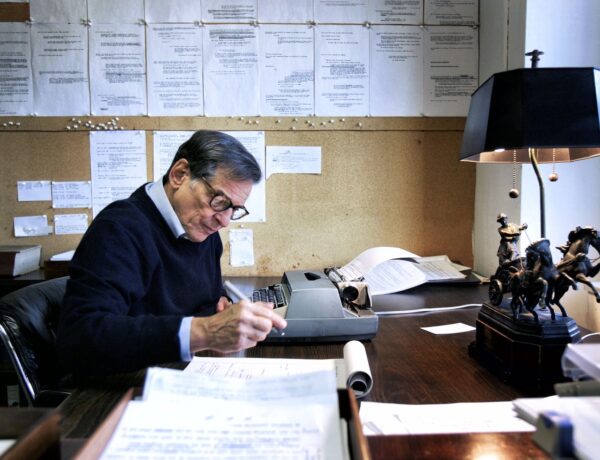
Russell Banks’ daily writing routine
Banks worked like a tradesman. Mornings were sacred. Six days a week, he walked from his house in the Adirondacks to a converted sugar shack overlooking a river—a quiet studio tucked in “splendid rural isolation,” as he called it. “That’s all I did. I just write. I don’t pay bills, I don’t entertain. I don’t do anything there except write.”
He typically wrote for four to five hours a day, almost always in the morning. That rhythm didn’t change, even when he retired from teaching and had his days entirely free. “I thought I’d have all this more time to write,” he once told the Washington Independent Review. “Turns out I still only wrote about five hours a day.”
His tools varied. Most days, he used a laptop. But when stuck, he shifted. “Every now and then I get frozen by it,” he told BOMB. “I have to return to the body in a more literal way and start writing out in longhand.” If that didn’t work, he’d pull out a typewriter or switch to a fountain pen and lined paper. The key was to keep moving forward. “I try not to stop until I know where I’m going next,” he said, following Hemingway’s advice to end each day mid-sentence if necessary.
Dialogue had to sound real. He often read it aloud to make sure. “I like to be able to be sure that I can hear it in my ears as human speech,” he said. “Not as written speech.”
He believed in voice as the entry point to character. “Access to speakers comes through language,” he said. “If you can hear the voice, you can speak in that voice, and then you can imagine the speaker.”
Banks also believed in listening, not dictating. “I’ve imagined myself less and less as a ventriloquist,” he said. “And more and more as someone listening to a character.” When writing Rule of the Bone, he pictured himself as the trusted listener. “Only when I could do that could I begin to transcribe what Bone seemed to say.”
He often emphasized that writing fiction wasn’t like writing nonfiction. “When you write fiction, you enter another world,” he said in Writers Digest. “It’s a little bit like hallucinating or out-of-body travel.” He called fiction “a controlled hallucination,” a space where the reader sees, hears, and inhabits a different life.
Though he spent much of his career teaching—at Princeton, Columbia, and Sarah Lawrence—Banks saw his job less as teaching writing and more as teaching reading. “That’s what we need to do,” he said. “Become more and more aware of what happens when we read. Then go back to the practice of writing and see how we can create the same effects.”
He was wary of academia’s pull, especially for writers. “The danger for a writer who teaches is the same as for a writer who preaches,” he told BOMB. “You come to identify with the institution… You can only do it if you continue to view it as temporary and tentative.” His solution: mutual exploitation. “The university is exploiting me and I’m exploiting the university, and I make no bones about it.”
Despite the accolades, the film adaptations, and the praise, Banks never let go of that early instinct to tell the truth—especially when it hurt. In The Paris Review, he described fiction as “a way of seeing the world or other human beings in the world a little differently, a little more clearly.”
And every morning, he walked down the hill to do exactly that.

No Comments